
Why I ditched Time-Outs for Meditation
For the first 5 years of my eldest daughter's life and the first 3 years of my younger daughter's lives, I had been practicing time-outs for discipline. I read in one of my parenting books that you should give time-outs based on age, 1 year olds receive 1 minute, 2 year olds receive 2 minutes etc. I found that time-outs never really worked. They worked for a short time and then within a few hours or days the act that caused my daughters to receive the timeout would recur. I sometimes started up-ing my game to "if you do that again I will take your (INSERT FAVOURITE TOY) away for 2 days!"
It didn't resinate with me. I don't enjoy talking like this, who does, really? I don't enjoy taking things from my children either, whether it be time, toys or whatever other "clever" punishment I could think of. Now keep in mind, my daughters are not terrible. They get in trouble for normal, age appropriate things.
I would put my daughters in time-outs, which I thought would allow them time to reflect upon what they had done, but instead they would scream and cry and just feel overall panic until their restriction was lifted. I thought, this is not working, this is only causing MORE anxiety for both myself and my children.
I had been practicing meditation for quite some time and I thought, why not try meditating instead? I knew that I would have to be careful not to put a bad stigma on meditation in their minds, or it could be lost to them forever. So I began teaching them meditation during times where they were not being punished.

We began with simple breathing techniques, (fill your tummy like a balloon and then let it out) and taught them to focus on their breath. We practiced just a few times and I soon was able to start implementing this with my eldest daughter when she was getting too excited at inappropriate times, like bed time (she often becomes this crazy and uncontrollable ball of energy right when it's time to go to sleep). To my joy, it worked! Focusing on her breathing helped her to calm down. I quickly realized, I'm not yelling, I'm not frustrated and neither is she. This is peace. This is giving my children the tools they need to help themselves. Instead of timeouts that resulted in her crying or acting out more, she was actively taking measures to calm herself down.
Next, I started teaching them Japa Mediation. I made them their own little Mala necklaces and taught them how to recite "Calm" or "Love". I was unsure whether they would take to this, especially my 3-year olds, but to my surprise, they LOVED it! My mala necklaces have 72 beads and I encourage my eldest (currently age 6) to recite her mantra all 72 times. She easily does this most times, but I do not put pressure on her if she wants to end early. It is their practice, not mine and I make sure that they know this and take what they can each time from their practice. I allow the twins to repeat as many times as they feel suitable. I am almost always surprised at how long they will actually sit there in peace, reciting their mantras.
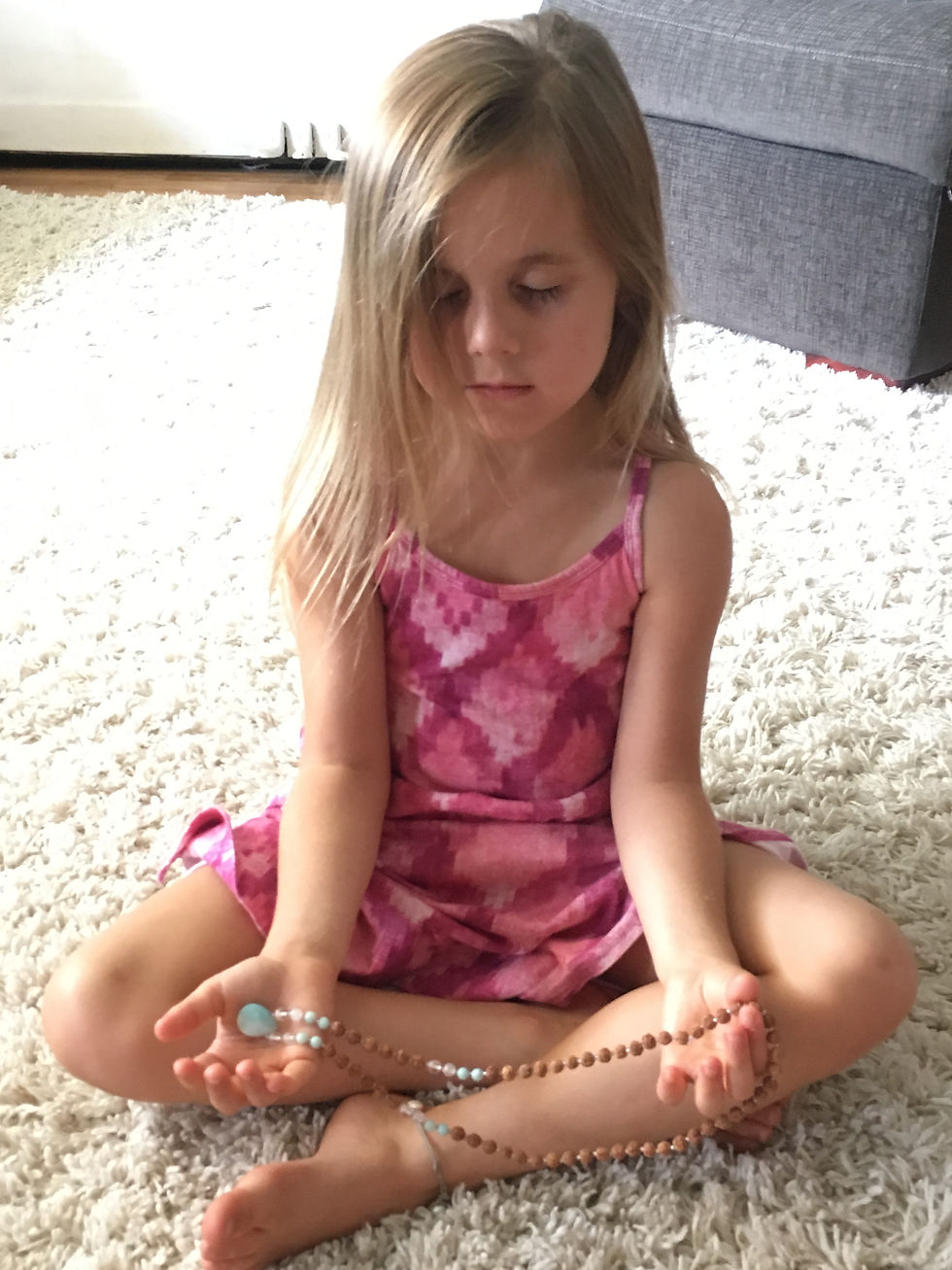
I also began doing guided meditations with them. This is a favourite guided mediation of theirs, please note that we never do the full 30 minutes. I let the girls do as long as they like, which is usually around 5 minutes and they sit criss-cross-apple-sauce and focus on breathing while listening and reflecting.

Now, when the girls are doing some punishable act, instead of yelling, "TIME-OUT" and pointing to their spot, I talk to them and I say, "I think you need some time of reflection, to meditate, do you?" I let them decide that they need to meditate, this way they associate it with their own decision and not a punishment. I then ask them which type of meditation they would like to do, "Would you like to do breathing-meditation, Japa meditation or a guided meditation?" They know which each one is based on those terms and they will pick one and sit in a quiet place, where they can meditate. I do not give them a time frame because then the only lesson they seem to learn is how long until freedom. I simply say, "Have a seat and when you're ready and you feel better come back to talk to mommy." I will also often sit with them and meditate beside them. They sometimes don't take as long as they would have with a time-out, but they often take even longer.
They come back with a clear mind, feeling more calm, more grateful and more empowered, because they chose to take their actions into their own hands. It is very liberating for all of us.
If you feel like implementing this into your home as well, just be mindful that you are not making mediation a punishment. Allow them to make the choice to take time for themselves, disconnected from electronics and other distractions, able to focus on their own soul, well-being and spiritual journey.
We have switched from Time-Outs to Mediation for about 6 months now and have found that the girls are having fewer tantrums and times where they cannot control themselves, they are more calm, and self-regulated and are sharing and sleeping better.
In recent years researchers have performed studies on the effects of mediation on children. They have found that meditation can help children in a variety of ways including;
decrease anxiety and stress
increase focus
increase grades
better parent-child relationship
improved wellbeing
reduce worries
reduce negative behaviour
reduced reactivity
improved sleep
improved self-esteem
more general calmness and relaxation
more self-regulation and awareness
In a 2007 study, symptoms of ADHD were shown to decrease after implementing meditation into a child's life.
There are absolutely no negative side-effects to meditating. This is an easy and safe way to bring a deeper peace into your's and your child's life.
Remember too, children are lead by example, all of these positive side-effects are true also for adults. We are living in a very fast-paced, work-oriented, stressful world. Suicide rates and mental health disorders are at an all-time high. Taking time for yourself only shows your children the importance in taking time for themselves. Hopefully we can raise our children to be more aware of mental health disorders and ways to help themselves.
Namaste
Michelle G


Comments